Friday, August 15, 2014

Indigenous Representations in Contemporary Art and Architecture


7/11/14 - Palacio de Bellas Artes, Mexico City - Jaguar Warrior Head
7/11/14 - Palacio de Bellas Artes, Mexico City - Eagle Warrior Head


7/11/14 - Palacio de Bellas Artes, Mexico City - Tlaloc Door Ornamentation
Construction on this building originally began in 1904 but wasn’t inaugerated until 1934. At the beginning, the structure was intended to be finished by 1910 as part of the 100 year anniversary of Independence. However, construction conflicts arose as did the Revolution and put a halt on the project. However, given the timing, this building offers a look at two different periods in Mexican history: the end of the regime of Porfirio Diaz with his nod to European style and the Revolutionary period with the final work housing murals by of the most renowned Mexican muralists of the time (Mexican Tourist Board 2012).  For the artists of the Revolution, it was “The return to native values, spiritual and artistic, which is a simplified description of modern Mexican art, in the case of the founders of this new tradition often occurred by way of modern European art” (Brenner 2002).

7/13/14 - Instituto Cultural Oaxaca, Oaxaca, OAX - Protest Poster with Speech Bubbles and Footprints

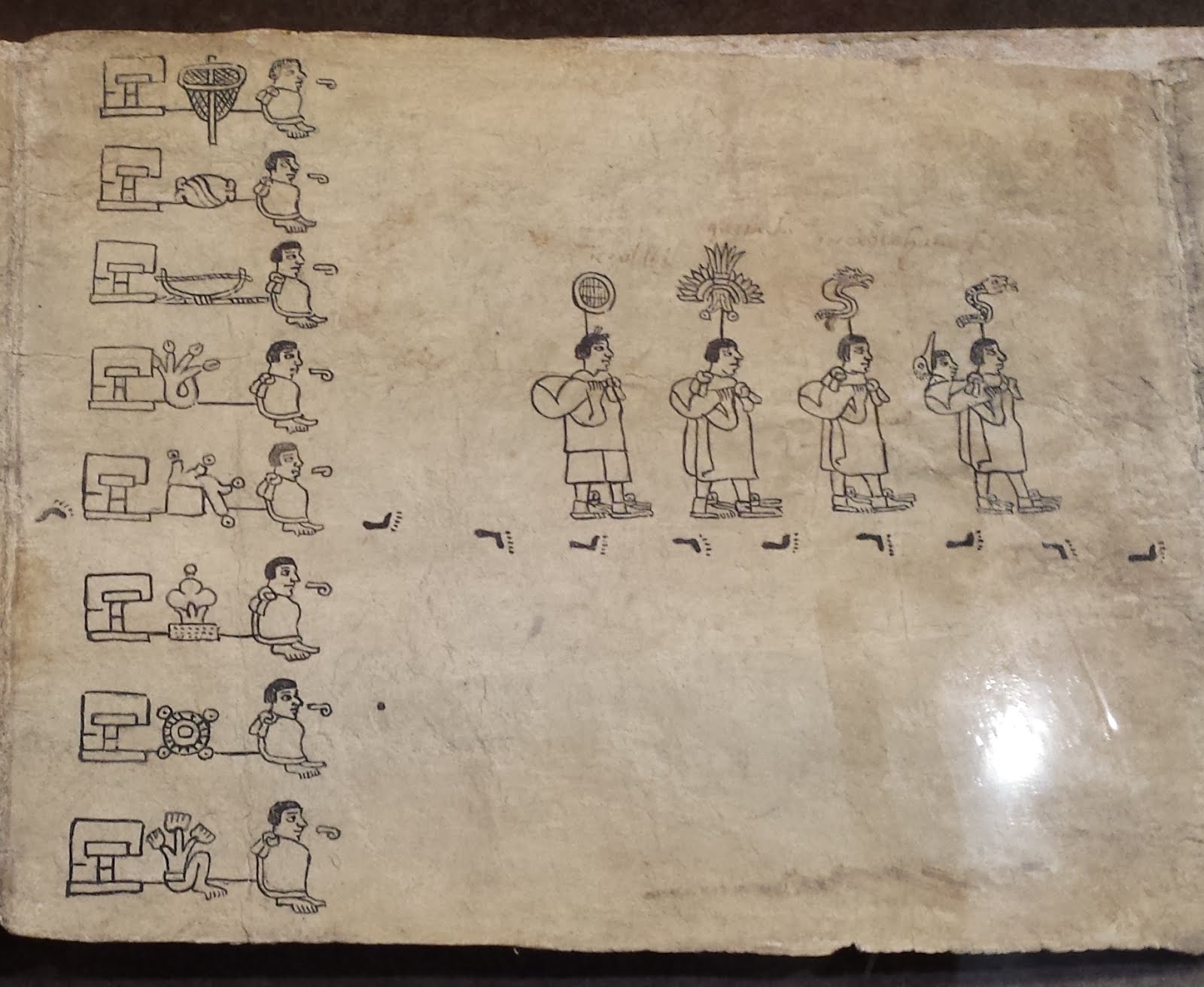
We were no strangers to protests while in Mexico. This image uses footprints as an indicator for movement or pathway. It also uses speech bubbles, which are commonly seen in codices indicating, communication. Examples of these forms of iconography are present in the mythology of Aztec origin codex:
20140808_121951.jpg
8/8/14 - Museo Nacional de Antropologia, Mexico City - Excerpt from Aztec Origin Codex


7/13/14 - Porfirio Diaz (Road? Avenue?), Oaxaca, OAX - Bridge Ornamentation Featuring (likely) Cosijo

7/13/14 - Porfirio Diaz (Road? Avenue?), Oaxaca, OAX - Bench with Unknown Figures
Zapotecas make up the largest group of indigenous peoples in Oaxaca and as such, it was common for us to see descriptions at museums and archaeological sites offered in Spanish, English, and Zapotec. It was also common for deities and artistic styles attributed to the Zapotecas to appear throughout the city. Though I cannot be certain about the deity on the bench, the style is reminiscent of the geometric patterns commonly found in Mitla. The image Cosijo on the bridge is nearly identical to several ceramic sculptures we viewed at the Museo de las Culturas de Oaxaca.

7/15/14 - José López Alavez (Road? Avenue?), Oaxaca, OAX - Mural by artists Búho Villamil and Lucia Rivera G.
I looked for an explanation for this particular image and was unsuccessful. The artists who created this vivid mural have created many other beautiful pieces and I recommend looking them up on Facebook. Besides the image, one of the most striking features about this mural that I noticed is the color pallette. It seems to me that the artists chose to stick with traditional colors and hues that were often used on not only the frescos, but the exteriors of buildings. These ranges of colors were seen on ceramic sculptures in the Museo de las Culturas de Oaxaca, on the frescos in Teotihuacan, and on the recreated exterior of the Temple of Quetzalcoatl featured in the Museo Nacional de Antropologia in Mexico City.
7/16/14 - José López Alavez (Road? Avenue?), Oaxaca, OAX - Mural Image 1: Note the Speech Bubble in Yellow to the Right of the Large Window

7/16/14 - José López Alavez (Road? Avenue?), Oaxaca, OAX - Mural Image 2.

I originally had seven pictures of this mural because it was covering a wall that spanned nearly half of a block. Beyond the one speech bubble visible in Image 1, there are also geometric patterns similar to those seen at Mitla. The images used in this mural vary, though I commonly saw small sections which resembled compasses. For several known ancient Mesoamerican cultures, the cardinal directions were important to elements in religion and spirituality. To further reinforce the common use of indigenous elements or imagery, take a moment to use Google Street View for this section of wall to see how it was previously adorned: https://www.google.com/maps/@17.076205,-96.722913,3a,75y,130.58h,75.75t/data=!3m4!1e1!3m2!1s8prNkJ4q2I4AHFbJIbLjzQ!2e0


7/26/14 - Carretera Internacional, Oaxaca, OAX - Monument to Benito Juarez (the glyph likely represents "Oaxaca")

This is one of many monuments/memorials for Benito Juarez. Juarez, known also for his Zapotec heritage, has become a figure of mythical proportions and is widely celebrated throughout the world. This monument celebrates his life and accomplishments. It includes a glyph that to the best of my searching appears to be the symbol for “Oaxaca" featured in the bottom left-center of the mosaic.

8/7/14 - Filomeno Mata, Garden of the Triple Alliance, Historic District Mexico City -  Bronze Castings of Two of the Three Leaders of the Aztec Triple Alliance: Izcoatl and Nezahualcoyotl
Mexico City was once the seat of the Aztec rule and though very colonialized, there are references to the former occupants. In the image above are two of the three leaders responsible for the Triple Alliance:  Nezahualcoytl of Texcoco, Izcoatl of Tenochtitlan, and Totoquihuatzin of Tlacopan. These three worked to create a unified Mexica rule over the surrounding cities.

The image below adorns the Palacio Nacional and presents the State symbol of Mexico situated between an Eagle Warrior and a Spanish Conquistador. This building was established at the time of conquest and was specifically built on the ruins of the palace of Mocteczuma Xocoyotzin on orders by Hernan Cortes.

8/7/14 - Palacio Nacional, Historic District, Mexico City - The Eagle in the Emblem Faces an Aztec Eagle Warrior


8/3/14 - Plaza Santo Domino de Guzman, Oaxaca, OAX - Image 1: The Base is Reminiscent of Carved Tzompantli Skulls


8/3/14 - Plaza Santo Domingo de Guzman, Oaxaca, OAX - Image 2: The Base is Reminiscent of Carved Tzompantli Skulls
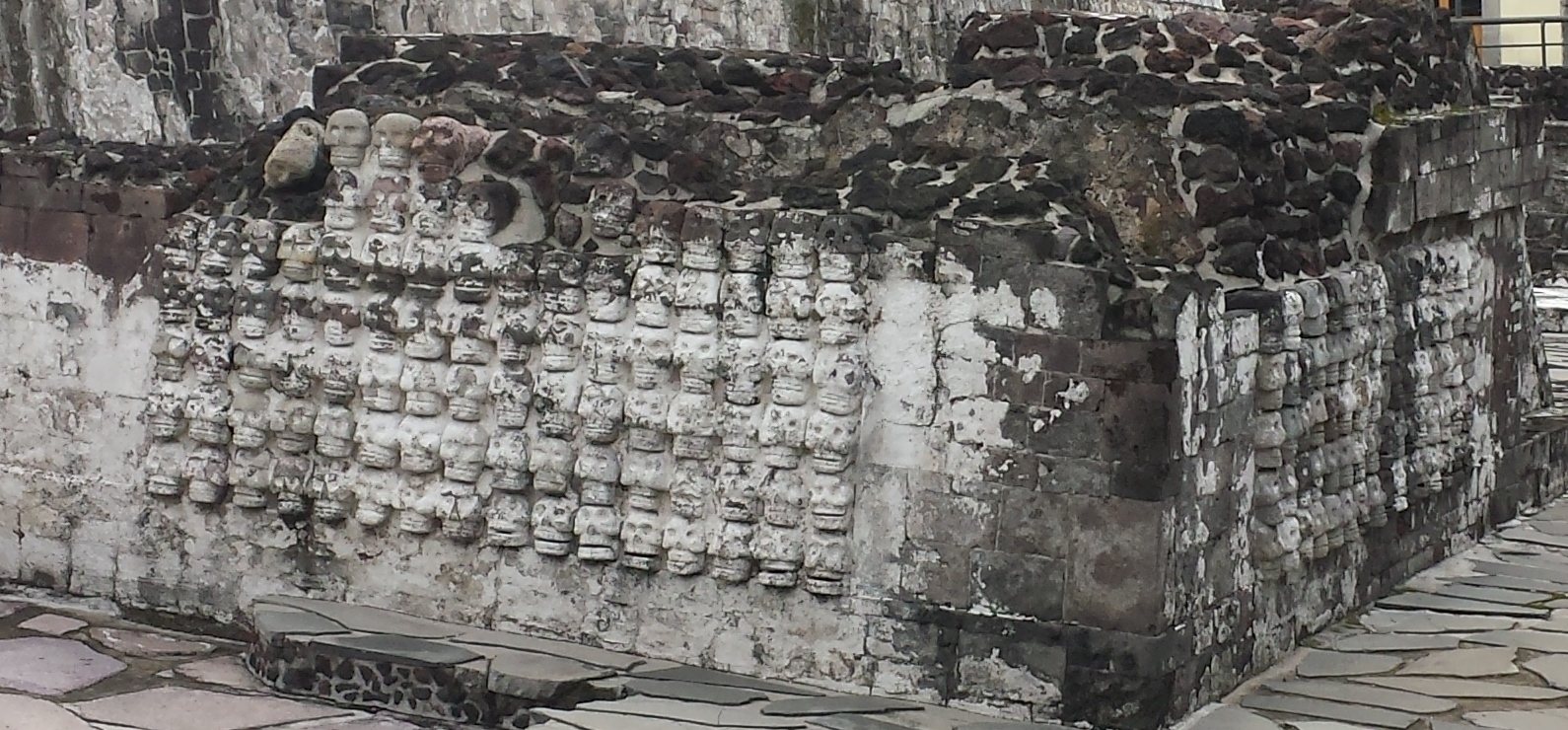
These sculptures were another interesting addition to the Plaza de Santo Domingo de Guzman in Oaxaca. From a distance, the engravings on the animals look glyph-like, but they are not. The bases of each animal (not specifically indigenous to the country) are covered with skulls. I was not able to locate further information regarding the artist or their intent behind each engraving, however, the style of the skulls resemble those seen at Templo Mayor in Mexico City:
20140808_161722.jpg
8/8/14 - Tenochtitlan, Mexico City - Tzompantli


8/7/14 - Interior Palacio Nacional, Historic District, Mexico City - Section of Diego Rivera Mural Highlighting Pre-Conquest Indigenous Groups


Diego Rivera’s mural inside the Palacio Nacional accounts the history of the Mexican people from the time of Quetzalcoatl to 1930. Impressively, Rivera does not hold back in painting painful, tragic, and even controversial events. He illustrates the abuses that were heaped upon the Aztecs by the conquerors and finishes this mural by illustrating the abuses heaped upon the laborers by elite.

--------------
One of the most refreshing aspects of my Mexico experience were the thriving indigenous cultures. These cultures survive for a number of reasons. Firstly, there are 15 recognized languages of Mexico: a number that does not reflect the scores of dialects within those languages. Secondly, it is estimated that the Spanish were responsible for killing approximately 95% of the indigenous population. Many people of Mexico are Mestizo, a mix of indigenous and Spanish descent, however some groups have maintained purely indigenous bloodlines for hundreds of years. For these people, culture and heritage is maintained through preservation of language, dance, clothing, and often art.


Sandra Rozental writes in her piece, “Stone Replicas: The Iteration and Itinerancy of Mexican Patrimonio” about how cultural identity also exists through location. In Coatlinchan, for example, the conquered people had a relationship to a monolith of Tlaloc and their imposed patron saint, San Miguel. Each deified figure had significance. The relationship to these figures was more than pride, it was a sense of cultural ownership. When the State enacted patrimonio nacional, the ownership of history became the right of the masses and not of the few, per the demands. Patrimonio was created for numerous reasons, including to preserve the remaining history and as a means to prevent artifacts from leaving the country. However, this also meant that the government could take possession of any and all artifacts and had complete control over their use and placement. This created a deficit for the people of Coatlinchan when the State removed their Tlaloc and installed it in the Museo Nacional de Antropologia, effectively stealing a piece of history from the community that had existed around it for hundreds of years or more. “...19th-century scholars found this Coatlinchan monolith and other pre-Hispanic artifacts to be tangible traces of an ancient civilization, and an alternative, non-Spanish and non-Christian patrimonial anchor for the new geneaology of the nation” (Rozental 2014).

A supplement to patrimonio nacional is the right of the State to produce many recreations of the “reclaimed” artifacts.Though the use of recreations can have positive attributes, the abundance of recreations for particular artifacts falls into commercialization. Rozental writes, “...I analyze the multiplication of the monolith as an index of Mexican modernity in the shape of miniatures and souvenirs that materialize the State’s ideological project of mestizaje” (2014). People who have histories and mythologies invested in these original artifacts are less than enthusiastic about the reproductions. For the Tlacauches and the people of the Coatlinchan, they eventually created a life-size replica and performed a ceremony during which they imbued the statue with the powers of the original.


Yes, the State uses patrimonio nacional for the purpose of secured preservation of artifacts and national heritage. Most of the nation is mestizo, making them of mixed Indigenous and Spanish origin and there is a strong sense of nationality present. However, according to Octavio Paz in The Labyrinth of Solitude, that sense of pride was not immediate: “The Mexican and his Mexicanism must be defined as separation and negation. And, at the same time, as a search, a desire to transcend this state of exile” (1985). For Paz, exile was a sense of not belonging to either group, but rather a new group of Mexicans who were orphaned through the Conquest and continue to search for their place. Independence from Spain asserted that Mexico was something different and “After a hundred years of struggle the people found themselves more alone than ever, with their religious life impoverished and their popular culture debased. We had lost our historical orientation” (Paz 1985). The Revolution was the next step to try and reunite orphaned Mexicans with the Mexico they had fought for and inherited.

Anita Brenner shares in Idols Behind Altars: Modern Mexican Art and Its Cultural Roots:

“In the span of one generation Mexico has come to herself. Her first and definitive gesture is artistic. While the government shifts and guerillas still battle for Cristo Rey  and other interests, the builders, necessary as the destroyers, refound the nation. It is a nation which establishes a school for sculpture before thinking of a Juvenile Court, and which paints the walls of its building much sooner than it organizes a Federal Bank. Sanitation, jobs, and reliably workable laws are attended to literally as a by-product of art: for the revolution is a change of regime, because of a change in artistic style, or if one wishes a more usual description, of spirit.”

These images are mixes of the old and the new: generations of Mexicans who are still working to find themselves in the past and present.

------------------------------

Bibliography:

Brenner, Anita. Idols Behind Altars: Modern Mexican Art and Its Cultural Roots. New York: Dover,
2002. Print.

Paz, Octavio. The Labyrinth of Solitude: and The Other Mexico Return to the Labyrinth of Solitude
Mexico and the United States The Philanthropic Ogre. New York: Grove Press, 1985. Print.

Rozental, Sandra. "Stone Replicas: The Iteration and Itinerancy of Mexican Patrimonio." The
Journal of Latin American and Caribbean Anthropology. Vol. 19. No. 2 (2014): pp. 331-356.
Web. 14 Aug. 2014.

"Aztec: Fierce Wanderers." Nature on PBS. Thirteen Productions, LLC., 2014. Web. 15 Aug. 2014.

"Bellas Artes Palace." Visit Mexico. Mexico Tourism Board, 2012. Web. 15 Aug. 2014.

"Murals." Palacio Nacional Mexico. Secretaria de Hacienda y Credito Publico, n.d. Web.15 Aug.
  2014.


Jewelry of Mexican Culture

Gold from Tomb 7
Oaxaca, Mexico


Jade mask from Tomb 7
Oaxaca, Mexico


Jade from Tomb 7
Oaxaca, Mexico


Obsidian
Mexico City, Mexico


Necklace made from shells
Mexico City, Mexico


Necklaces made from shells
Mexico City, Mexico


Gold beads and pendants
Mexico City, Mexico


Bronze ear plugs and choker
Mexico City, Mexico


Jewelry made from metals and beads
Mexico City, Mexico


Stone ear plugs and necklace
Mexico City, Mexico


Necklace made of gold (left), 
necklace made of stone and gold beads (right), 
gold and bronze pendants (center)
Mexico City, Mexico


Adornments of gold and turquoise (center)
Mexico City, Mexico


Various stones and shells for sale
Mexico City, Mexico


Jewelry of Mexican Culture
 Christina Gruzdov

Beautiful jewelry can be found all over Mexico. It is treasured both for its artistry and its value in cultural heritage. In pre-Hispanic times, Oaxaca had an abundance of gold deposits that were readily available for crafting.  Gold and silver were predominantly used for religious ceremonies. Gold represented the sun and silver was associated with the moon. When the Spanish arrived in Mexico, they dismantled the jewelry industry in order to prevent the worship of native gods. Friars and priests then instructed Oaxacans, in Spanish techniques, to create religious pieces, such as crucifixes. There is a major contrast between the accessories of ancient cultures and modern day Mexico. Jewelry made of gold in that epoch was of superior quality. It is difficult to reproduce it to the same quality today, even with our advanced technology. Gold and silver were not the only materials used. Throughout the different regions of Mexico, people used bronze, shells, amber, jade, obsidian and various types of rocks.

Mixtec Goldsmiths
All the gold that was exchanged between the Mesoamerican elites came out of Oaxaca. It was obtained from the sands of rivers around Chinantla, Sosola and Tututepec. Goldsmiths used several techniques in hot and cold variation including: welding, smelting, cutting and embossing. The tradition of the Mixtec goldsmith peaked in 800 A.D. They were renowned for a technique called “false watermarking.” This showcased a unique characterization of their designs as well as a high degree of refinement. At that time, their excellent artwork of gold, silver, copper and bronze was spread throughout the regions of Mexico. Archaeological excavations in Oaxaca have rescued several pieces from Monte Albán. 121 objects of gold, silver and jade were recovered.

Shells and Snails
Beautification of one’s self was common among high-born characters. Shells signified individuals of upper hierarchy. The shell ornaments formed an indispensable part of clothing and personal adornment, and were important indicators of social class. Bangles, bracelets, pectorals and gold foil were sewn to clothing. Imagination and creativity were poured into these delicate masterpieces. The Mixtec, along with many other groups, made all kinds of objects from shells and snails. An emblem of a “cut-snail” and a “feathered serpent” was used to symbolize the god of wind, who was also believed to be the creator of the Mixtec group.

Obsidian
Obsidian is a naturally occurring volcanic glass formed as an extrusive igneous rock. Basically, it is a rock that is formed when lava or magma cools, with minimal crystallization. It was associated with the god Yaa Chu’ma Inu, which stood for patron of the night. The obsidian industry was significant in Teotihuacan, as it maintained control over the raw material supply in Mesoamerica. They also controlled the distribution of finished goods. Craft development allowed the existence of specialized obsidian workshops. Jewelry was fashioned along with tools, such as: ceremonial knives, projectile points, prismatic blades, scrapers, masks, earmuffs, and much more. Obsidian adornments were used in great religious and civic ceremonies in their death rituals. Besides its ornamental function, it had other implications for social ceremonies and were associated with military practice as insignia of rank.

Amber
Amber was regarded as the sacred stone of the sea. Its color symbolizes the sun and relates to gold. It also evoked the color of the “new skin” of the earth before the rainy season. For this reason, it is linked to the god Xipe, who was the god of spring. He was also the patron god of goldsmiths. The pre-Hispanic amber ornaments include pendants, beads, ear plugs, nose plugs and lip plugs. The pendants have a perforation on one end and often follow the natural form of the pebble. Some pendants have also been found by archaeologists, representing ducks’ heads, such as in the collar from Monte Albán’s Tomb 7. Four pairs of amber ear spools were also discovered in the tomb.

Jade
It is assumed that the Mayans were the first to utilize jade. It was shaped into a variety of objects, including figurines, ear spools, belt décor, pectoral coverings and teeth inlays. The most popular of jade objects were ear spools. They were worn to enhance and advertise the status of the wearer. Jade was found in Monte Albán’s Tomb 7. This is evidence of trade between cultures. The Zapotecs used their arts to commemorate the living and also to accompany the dead to the afterlife. More than 150 elaborate tombs were found within the ruins of Monte Albán containing jewelry and figurines made of gold, copper, jade, obsidian and more.

Today
There is a contrast in today’s Mexican culture pertaining to jewelry. Half of the industry makes handmade in-house authentic pieces that reflect their culture and the other half completely modernize their collections. Artisans producing jewelry in the traditional manner have felt pressure from overseas because much of the jewelry sold in Oaxaca today was manufactured in China. This art needs to be preserved. There is a shop in downtown Oaxaca called Oro De Monte Albán. They were the first specialized shop for jewelry in that area. In 1985, they obtained the authorization of the National Institute of Anthropology and History of Mexico, to reproduce pre-Hispanic jewelry and jewelry that was found in Tomb 7. They replicate the jewelry of ancient civilizations and use the same techniques as the ancient cultures did in order to achieve the most authentic look.

In conclusion, jewelry had many different meanings within each culture. Some used it as status symbols while other cultures used it to honor the gods or the deceased. Enormous amounts of time and effort went into crafting the unique pieces of the past and are difficult to replicate with the same quality levels, even with our technological advancements. The Mexicans of ancient times had style. I would totally rock their jewelry!


WORKS CITED
Admin. “The Jewelry of Oaxaca.” Los Amigos Del Arte Popular. Feb 15 2012. Web. Aug 14
            2014. < http://www.ladap.org/jewelry-oaxaca/>
Museo Nacional De Antropologia. “Culturas De Oaxaca.” Mexico City, Mexico. 2014.
“Our Company.” Oro De Monte Albán. Web. Aug 14 2014. <http://www.orodemontealban.
com/our_company.php>
Wikipedia. Web. 2014.


Thursday, August 14, 2014

The Virgin of Guadalupe

07/06/14 Teotihuacán, México
Here the Virgin of Guadalupe is shown with blonde hair and a white complexion as well as with the angels. She is also not wearing the bow around her waist that represented her royalty and pregnancy. 
07/06/14 Market Teotihuacán, México
The image of the Virgin of Guadalupe is simple. The complexion of her and the angel are darker showing the indigenous side. 
07/06/14 Market Teotihuacán, México
Here the color of the Virgin of Guadalupe's clothes are blue and a brownish color instead of the blue-green color, along with this she has black hair and a white complexion. This image was also made with the thread from the inner part of the Agave plant. 
07/05/14 Puebla, México
Here the image of the Virgin of Guadalupe is softened. Her cheeks are rosy as well as the color of her mantle and dress.

07/06/14 Teotihuacán, México
This is a more traditional picture of the Virgin of Guadalupe.
07/06/14 Teotihuacán, México
This is a ring with the Virgin of Guadalupe on it. Here her mantle is blue and instead of stars there are flowers surrounding her.
07/06/14 Market.  Teotihuacán, México
This is a completely different representation of the Virgin of Guadalupe. Unlike the traditional one, she has no details. It simply is a more round outline of the image.
07/06/14 Market. Teotihuacán, México
The Virgin of Guadalupe here is carved into a piece of obsidian. It is very detailed and beautiful.

07/06/14 Market. Teotihuacán, México
This is a pretty unique representation of the Virgin of Guadalupe. Here she is outlined by roses and her mantle is plain.


07/08/14  México City, México
Here two angels are giving the Virgin of Guadalupe a crown. In addition her mantle is a royal blue color and her hair is brown compared to more traditional images.
07/08/14 México City, México
This is a much darker representation of the Virgin of Guadalupe. This image was printed on a postcard. Here not only is her complexion darker, but so is her wardrobe. Also instead of stars on her mantle she has a different design. 

07/08/14 México City, México
This is a really beautiful picture of the Virgin of Guadalupe that is on the side of a picture frame. Once again, instead of stars on her mantle, she is surrounded by flowers. She has a whiter complexion as well as a deeper blue colored mantle compared to the blue-green one.


The Virgin of Guadalupe

Before the Spanish arrived in México, the indigenous groups that occupied the area each worshiped different gods. During this time there were many great indigenous groups. One of the great groups known as the Aztecs worshiped 5 gods. These gods were Tezcatlipoca, Nanauatl, Ehecatl, Quetzalcoatl, and Huitzilopochtli. According to the article Ancient Aztec Religion, Tezcatlipoca was the god who turned into a jaguar, Nanauatl was the god who became a sun that made no movements, Ehecatl was known as the god that sacrificed himself and the other gods in order for the humans to live, and Quetzalcoatl was known as the feathered serpent god who created the humans. Lastly, Huitzilopochtli was known as the god of war. To the Aztecs, these gods represented the sun, the destruction and creation of the world, and the lives of humans. According to the same article, the humans were given life due to the sacrifices each of the gods made. As a result, the Aztecs were to repay this debt by blood as well, which resulted in sacrifices. What the indigenous people didn’t realize a new threat would come along and change their lives forever; the Spanish.

 The arrival of the Spanish changed the lives of the indigenous groups just as stated. With Hernán Cortés as the head of the Spanish army, the indigenous people were forced to forget who they were and forced to follow new traditions, customs, and a new religion. Their land had been taken over by Spain and their civilizations ruined. This can easily be seen with the Templo Mayor, which was the main temple for the Aztecs. The Spanish had torn it down to build the Metropolitan Cathedral of the Assumption of Mary of Mexico City. Today in México City one can still see the ruins of the Templo Mayor right next to the Cathedral. In addition, Mexico City actually sits on what was once the empire of the Aztecs that was known as Tenochtitlán.

Furthermore, during the Spanish rule, the Roman Catholic Church played a huge role in shaping the people of México and the country through religion. According to the article Religion, “[Hernán Cortés] was accompanied by Roman Catholic clergy. All new Spanish territories were to be conquered in the name of the cross as well as the crown.” With this, the gods that the indigenous groups worshiped were pushed aside. The people were forced to follow the catholic religion and adapt to the many practices that came along with it.

One of the pillars of the catholic religion that is seen all throughout Mexico today is the Virgin of Guadalupe. The Virgin of Guadalupe is actually another form of the Virgin Mary. The people of México identify with the Virgin of Guadalupe the most due to her appearance and the language she speaks. In addition, the article Our Lady of Guadalupe (Saints & Angels) states, “One of the more remarkable attributes of the Guadalupe of Extremadura is that she is dark, like the Americans, and thus she became the perfect icon for the missionaries who followed Cortés to convert the natives to Christianity.” The Spanish used it as a way for the natives to identify with something within the religion and which would benefit them converting the natives. If the people who are lost and confused can identify with something or someone who looks just like them and is treated very highly above all, then they will believe that their suffering and pain that they endured will stop once they follow in the practice of that saint. Furthermore, the same article goes on to confirm this by stating, “Guadalupe continues to be the mixture of the cultures which blended to form México, both racially and religiously, ‘the first mestiza,’ or ‘the first Mexican’ ‘bringing together people of distinct cultural heritages.” In other words, people are able to identify with the Virgin of Guadalupe due to her race and the cultures within being mestiza and/or Mexican. She is able to identify with the majority of the people of México.

In addition, according to the article Our Lady of Guadalupe (About), the history of the Virgin of Guadalupe started with a man named Juan Diego who was a poor Aztec man. On his way to visit a chapel on top of Tepeyac Hill, he came across a beautiful woman. This woman spoke to him in his native tongue explaining that she was the Virgin Mary and in addition, she requested a church built in her honor on top of the hill. Here she will be able to listen to the people and heal them. Soon after seeing her Diego ran to tell the Bishop as she had asked. As the Bishop was unwilling to believe him, Juan Diego returned to see Virgin Mary waiting for him. The article continues to state that she told him to keep trying and after failing to get the Bishop to believe him a few more times, Mary had sent Juan on a small mission to obtain flowers on the side of the mountain. With these flowers she made an image of her for the Bishop to realize that everything Juan told him was the true. During this, Juan had an uncle who was ill and as a result of him helping her, his uncle was cured. When Juan and the Bishop met with the uncle, the uncle said that the lady wanted to be called Santa María de Guadalupe. With this article, one can see the history behind how the Virgin of Guadalupe came to be and the trust she had for the people of México. 

In addition to this, every aspect of the Virgin of Guadalupe is symbolic, from the cloths she wears to the rays of light surrounding her. For instance according to the article called Symbolism of the Image, the rays of light around her represent “the light is also a sign of the power of God who has sanctified and blessed the one who appears […] the rays of the sun would also be recognized by the native people as a symbol of their highest god, Huitzilopochtli.” The crescent moon at her feet in which she is standing on represents “the moon for the Meso-Americans [in which] was the god of the night.” The angel that is holding her up with the moon represents the type of class in which she represents, that of royalty. The blue-green mantle that she wears has colors that represent a high status that she holds. The stars on her mantle signify that she is from heaven. Also the bow that is around her waist signifies her virginity as well as the way it is placed shows that she is actually pregnant. This article helps clearly explain every aspect of the Virgin of Guadalupe that is important. All of these aspects of the Virgin of Guadalupe have relation to the indigenous groups and how they view her. They turn to her when they feel helpless and when they need a miracle to happen. She holds a very important part in the lives of those who look up to her and praise her every day. With this people have their own interpretations of how she looks as well as how she should be represented. For instance with the pictures taken in México, although some of them may look the same, there are actually differences in the details, such as the color of skin, hair, and the color of her clothes. In one photo she has black hair with a white complexion and a blue mantle. Another she is blushing and her features are softer with a brighter green mantle. There are many different ways that the Virgin of Guadalupe is represented through pictures, statues, and more.


                                                                                       Works Cited

“Ancient Aztec Religion.” Aztec-history. N.p., n.d. Web. 12 Jul. 2014. <http://www.aztec-history.com/ancient-aztec-religion.html> 

“Our Lady of Guadalupe (About).” Catholic online. N.p., n.d. Web. 12 Jul. 2014. <http://www.catholic.org/about/guadalupe.php>

“Our Lady of Guadalupe (Saints & Angels).” Catholic online. N.p., n.d. Web. 12 Jul. 2014. <http://www.catholic.org/saints/saint.php?saint_id=456>

“Religion.” Countrystudies. U.S. Library of Congress, n.d. Web. 14 Jul. 2014. <http://countrystudies.us/mexico/61.htm>

“Symbolism of the Image.” Olgaustin. Our Lady of Guadalupe Catholic Church, n.d. Web. 13 Jul. 2014. <http://www.olgaustin.org/symbolism.shtml>


Mexican Cuisine

Making tortillas on a comal
Oaxaca, Mexico

Mocajete used to make salsa
Oaxaca, Mexico

Steak, fries, guacamole, and beans at VIPS
Mexico City, Mexico 

Entomatadas
Oaxaca, Mexico

Tres Liches Cake
Oaxaca, Mexico 

Cheese Quesadillas
Oaxaca, Mexico 

Salad, Rice, Salsa, fajitas, chorizo and fruits
Teotitlan, Mexico 

Fajitas with chicken covered in guacamole and cheese.
Teotitlan, Mexico

Helado made from kiwi
Puebla, Mexico

Tamales with cheese and chicken
Mexico City, Mexico

Chile en nogoda
Oaxaca, Mexico

Chicken crepes with tomato sauce
Oaxaca, Mexico


While in Mexico you see many different cultures from many different indigenous groups. As Mexicans take steps into the future you can still see glimpse of their past, such as, their architecture, languages, crafts, and foods. You can see the changes in how different indigenous groups eat. For instance, the people near the coasts usually eat more seafood, but people hours from the coast usually had a plant and grain based diet. Although times have changed and traveling has becoming quicker and easier, you can still see that their diets haven’t changed as drastically as thought. The reason for that being is that most of the crops needed for their meals are grown natively in their lands. Crops like corn, chili peppers, tomatoes, squashes, avocados cocoa, and vanilla. Most of these are used for their everyday meals.  The Europeans eventually brought over meats, fruits, and spices, which gave them more to contribute to their recipes.

Corn is probably the most used starch in Mexico. It’s most commonly ground down and mixed with lime, to make the dough that’s used for tortillas and other things; although it is also used for salsas, soups, and many other dishes. In the past Mexicans didn’t have flour so this dough ground from corn and lime, would be grilled on a comal (flat top stove) and be a nice flat shell in 10 minutes or so.  Corn not only had a major dietary involvement in the Mexican culture, but it also had great religious significance. The Mayans built temples for the god of maize and also used it as medicine. When people were sick they would limit their diet to just corn to bring them back to health.

Mexican food is well known for its food being spicy, this brings us to the importance of chili peppers and other peppers they use in their food. The Mayans and Aztecs used chili peppers with most of their food, because it “was thought to cure colds, strengthen the body, and relieve depression” (sbnature.org).  Although chili peppers didn’t heal everything they are medically good for stimulating the cooling center of the hypothalamus which helps cool the body, helps you salivate, and provides vitamins. Since then chilies are now used around the world in many different foods just for the spicy taste. 

Mexican cheese, one of the most popular things Mexico has to eat, but also holds a great tradition. Although cheese wasn’t developed till the Spaniards came to Mexico and brought dairy animals. Cheese has now grown in Mexico, it’s not the shredded kind in the bag we imagine, but it comes in many shapes and forms and can sometimes take months to make.  Mexicans learned how to make the cheese from the Spaniards and developed their own way of make it based on the tastes they favored.  Now we have many different cheeses like Oaxacan, Queso blanco, panela, and the list goes on.

Although food is widely made for eating it was also used for religious purposes and holidays. Before the Spaniards came the indeginous groups built temples and offered up food offerings to the gods, but after the Spaniards came and forced Christianity upon them. This led most of the holidays to become more of a festival.  So during Christmas they tend to have big family meals and the week before Easter they tend to do the same, but avoid meat. Also the Three Kings Day and The Day of the Dead they have festivals were they only eat specific foods.

Mexican culture hasn’t changed much in the way they prepare the food. In rural areas, most of the food is made at home and uses local ingredients. Traditional Mexicans consider cooking to be a women’s job and consider a girl ready to marry when she is capable of cooking. Usually the main meal of the day “begins with soup, … or a “dry soup”, which is pasta or rice flavored with onions, garlic and/or vegetables. The main course is a meat served in a cooked sauce with salsa on the side, accompanied with beans and tortillas and often with a fruit drink” (en.wikipedia.org).  Most Mexican food we are used to in the states is considered Tex-Mex. The real Mexican food takes hours to make and usually has much more flavor.

While in Mexico you will also notice many street vendors selling tacos, quesadillas, tamales, and so on. Although the sanitary of these venders are questionable, they provide a quick and tasty meal for those on the go or just don’t want to deal with family. One of the most popular items street vendors have are tacos, mostly because taco are quick, easy, and you can just stuff the meat and other toppings into a tortilla and have them on their way. You don’t have to give them any utensils the tortilla does everything they need. The second popular dish is the torta, which is a roll type bread stuffed with a meat, beans, or other filling. After the French came they introduced a new type of bread and it became a roll.  Still convenient and easy for the street vendors to use because people didn’t need utensils to eat it and they could be other their way. Then during the 20th century America brought its influence to the stands with hot dogs. Although the hot dogs made in Mexico have a different style consisting of hot dog wrapped in bacon and fried.

We can see the changes in food and the influences of other cultures on Mexico throughout its history. Starting from the indigenous tribes whose main source of food was plant based and hunting animals. Later on corn was discovered and the process to make corn tortillas, but still their main source of protein was from beans and other plants and animals from hunting.  When the Spaniards came they had a great influence from them and received many new animals and foods. Animals such as cows, pigs, goats, and others, and these animals provided a changed in their diets. Also along with the Spaniards influence came the Arab influences as well. Lastly, as mentioned before, the American influence on Mexico in the 20th century, which brought pizza, hamburgers, and hot dogs into the Mexican diet.


Bibliography


"Mexican Cuisine." Wikipedia. Wikimedia Foundation, 08 Oct. 2014. Web. 14 Aug. 2014.
King, Sabina. "The Secret of Mayan Corn Tortillas." A Kings Life. N.p., 3 Feb. 2012. Web. 14 Aug. 2014.
Timbrook, Jan. "SBMNH: Collections & Research Anthropology Anthropology Research Ethnobiology - Reports & Articles The Natural History of Chile Peppers." SBMNH: Collections & Research Anthropology Anthropology Research Ethnobiology - Reports & Articles The Natural History of Chile Peppers. N.p., n.d. Web. 14 Aug. 2014.
"Food in Every Country." Food in Mexico. N.p., n.d. Web. 14 Aug. 2014. <http://www.foodbycountry.com/Kazakhstan-to-South-Africa/Mexico.html#b>.